
Enabling high-SCM, low-CO₂ cements without compromising workability or strength

The decarbonization of cement demands high clinker substitution with supplementary cementitious materials (SCMs), yet this transition is frequently limited by increased water demand, workability loss, and early-age strength deficits.
EnviroAdd® HWR – a next-generation, polymer-based cement additive, is designed to survive milling conditions and stabilize rheology in SCM-rich binders, enabling deeper clinker reduction ahead of 2030 targets.
An Engineered Platform for SCM-Rich Systems
EnviroAdd® HWR combines chemical accelerators, high-performance polymer structures, and synergistic packages targeting multiple mechanisms simultaneously: hydration kinetics, water demand, microstructure refinement, and rheology. This allows cement producers to adopt higher SCM substitution rates without sacrificing workability or mechanical performance.
The polymer architecture adsorbs onto clinker and SCM surfaces, breaks down agglomerates to release trapped water, and maintains dispersion as hydration progresses – ensuring stable slump retention for 60 minutes or more. Mercury intrusion porosimetry confirms reduced pore sizes and improved connectivity, particularly pronounced in calcined clay and pozzolan systems.
Hot-grinding robustness was evaluated using a proprietary Chryso protocol reproducing the combined effects of time, temperature, and water addition. Two engineered polymers form the basis of the platform: one offering high initial water-reduction efficiency with strong post-grinding performance; the other showing improved properties after grinding, attributed to its molecular architecture.
Mini-slump flow of Polymers B1 and B2 comparing addition during grinding (G) versus addition to mixing water (MW), illustrating the degree of performance retention after exposure to grinding conditions.
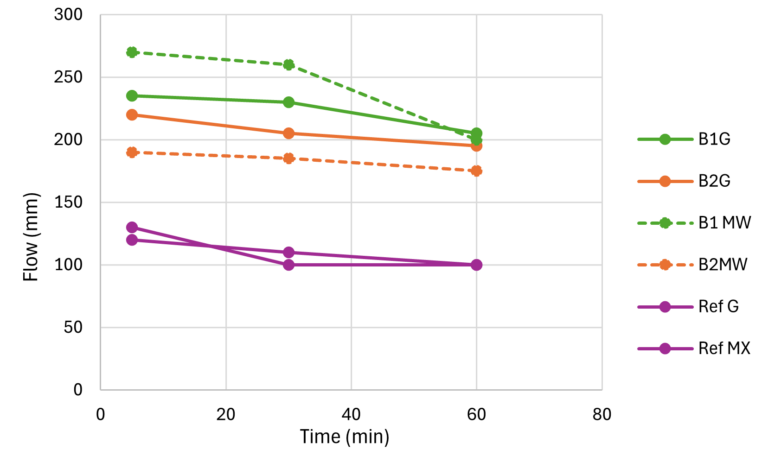
Figure 1: Robustness of polymers in milling conditions evaluated at Chryso Research Lab
Industrial Performance – Quantified Results
US case study – Fly ash to calcined clay cement
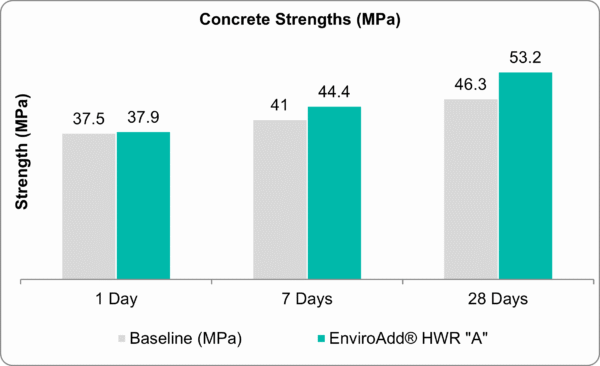
A customer sought to convert a 21% fly ash cement (400,000 t/year) into a 35% calcined clay Type IP cement with stable or improved concrete performance. EnviroAdd® HWR05 at 3,400 ppm was compared against the standard Tavero GA03 at 450 ppm.
Key results:
-
- +23% initial slump and a rheology loss of less than 15%
- +18% Strength at 1 day (+4 MPa)
- +22% Strength at 28 days (+13 MPa)
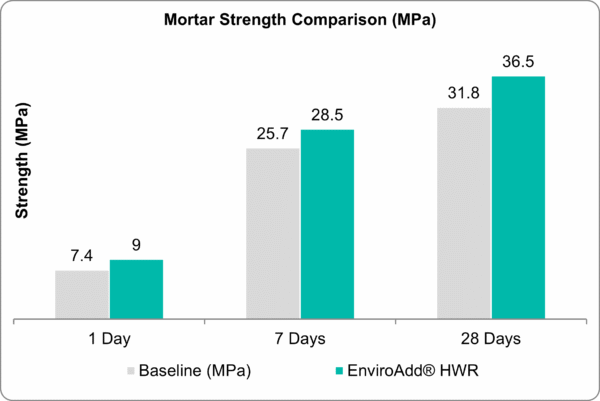
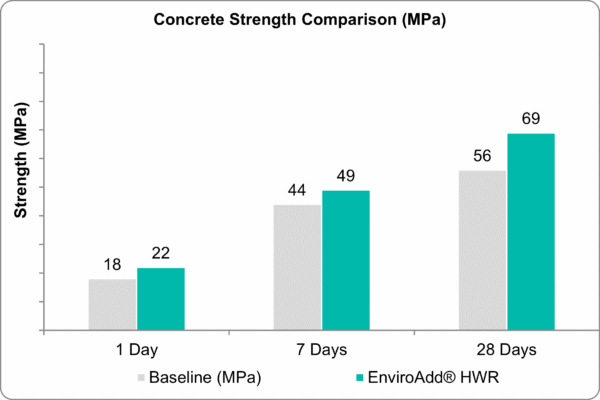
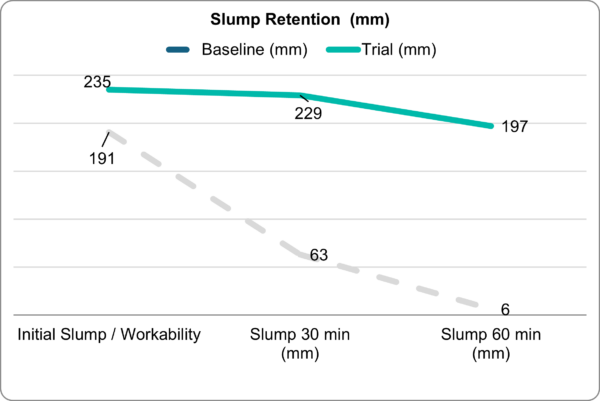
Figures 2, 3 & 4 – Mortar and concrete compressive strengths and workability on calcined clay cement. Results at W/C = 0.38, constant plasticizer dosage and water-to-cement ratio.
Turkey case study – Increasing Limestone in pozzolan cement
A plant producing CEM II/AM (PLL) 42.5R with 10% natural pozzolan and 5% limestone sought to move to CEM II/BLL (additional 8% limestone) while maintaining concrete performance. Two EnviroAdd® HWR products were selected against a pure accelerator baseline.
Key results:
-
- +30% Initial flow at fixed W/C 0.5
- -8% W/C reduction at fixed flow
- +15% Strength gain vs. activator (+7 MPa)
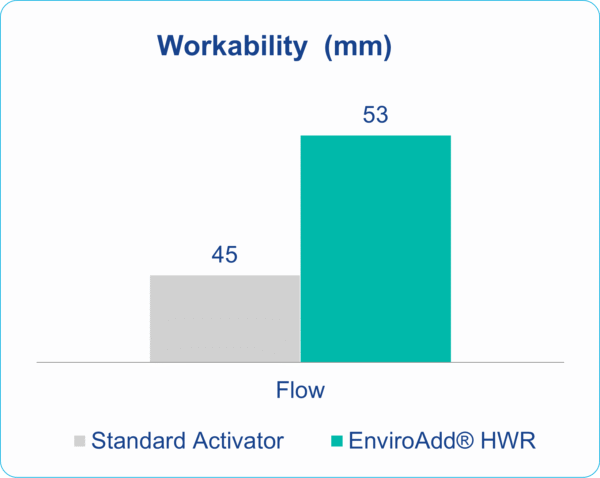
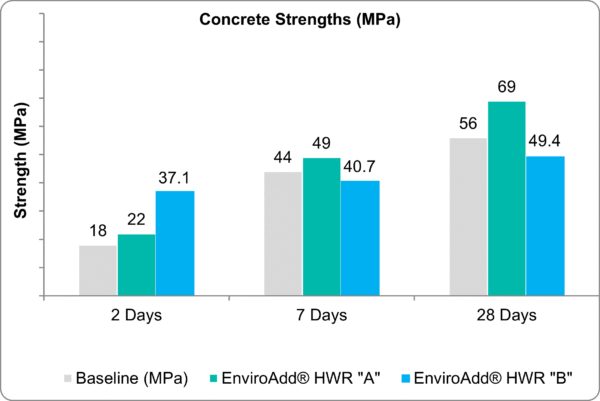
Figures 5, 6 & 7 – Workability and strength at fixed W/C and fixed flow. Gradual strength increase between 7 and 28 days under reduced W/C conditions. Customer reduced the clinker factor by 8 percentage points.
Conclusion
EnviroAdd® HWR provides cement plants with a robust, field-proven pathway to accelerate decarbonization while maintaining cement and concrete performance. By simultaneously addressing hydration, rheology, microstructure, and grinding robustness, it stands as one of the most impactful levers available for high-SCM systems over the next decade. Chryso at Saint-Gobain delivers an integrated, smart offer across the entire value chain – from cement production to concrete performance on the job site.
Estelle Raynaud, Cement BU Technical Director
Caroline Autier, Team leader in Cement additive R&D’s
Chryso R&D, Saint-Gobain
Keywords
SCM-rich cements · high-range water reduction · rheology · slump retention · mecanical performances · natural pozzolan · LC3 · low-CO₂ binders · hot-grinding robustness · concrete performances